
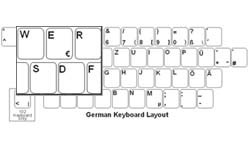

The DataCal Liechtenstein (German) language keyboard labels are a high-quality, durable and economical solution to creating a Liechtenstein (German) bilingual keyboard.
In stock
Regular Price: $12.95 On Sale For: $9.95 |
|||||||||
Specifications
Features
Setup
Use
Specifications The Liechtenstein (German) keyboardlabels conform to the Liechtenstein (German) keyboard layout in Windows. Thelabels are printed on clear Lexan® so the original key legend shows through;this allows you to add Liechtenstein (German) labels to your existingkeyboard so that it becomes a bilingual keyboard (Liechtenstein (German) and theoriginal language of your keyboard). The labels are available in blue letterson clear labels (for beige and light colored keyboards) and white letters onclear labels (for dark colored keyboards). The Liechtenstein (German)keyboard labels supports the keyboard layouts in German (Germany), German(Austria), German (Liechtenstein), and German (Liechtenstein). This languageis supported in Windows Vista, XP, ME, 98, and 95. Liechtenstein (German) labels are a very economical option for creating a bilingual Liechtenstein (German) keyboard. The language labels use an easy peel-and-stick method to install.They will not damage the original keyboard key. Theletters are printed on the underside of the Liechtenstein (German) labels so that the lettering will not wear out. This affords you with manyyears of durable use. DataCallanguage labels are designed to fit desktop and laptop computer keyboards.Laptops with smaller than standard keys may not be compatible with the DataCallabel sets. Labelsize: 7/16" w X 9/16" H (11mm W X 14mm H) Features
How to Setup Windows for this Language You must first configure Windows for the German (Liechtenstein) keyboard layout. After you configure Windows, you will be able to manually select the language when you wish to use it. For additional information on language setup, see the Windows Help file system of contact Microsoft technical support. Setup instructions for Windows Vista Instructions for TypingGerman in Windows Deadkeys The German keyboard layout uses a systemof deadkeys (highlighted in yellow below) to type certain accented characters.To use the deadkey system, first type the deadkey; nothing will appear on thescreen. Next, type the key (generally a vowel) that you wish to combine with thedeadkey. You should then see the accented character that you want on the screen.If you press a deadkey and then a press a key that does not go with that accent(such as pressing an accent and the number "2"), nothing happens; theaccent deadkey must be correct to work. Depending upon the language, deadkeyswork with both unshifted and shifted keys. The AltGr Key Many languages include more characters than canbe typed on a standard computer keyboard. To solve this problem, additionalcharacters may be assigned to the right AltGr key (the right Alt key) and/or theShifted AltGr key. In Europe, the right Alt key is referred to as the AltGr key.In the United States, it is merely the right Alt key. It is important to notethat the left Alt key cannot be used as the AltGr key.
The 102 Style Keyboard This language uses the European style 102keyboard layout. This keyboard layout features a key in the lower left corner ofthe keyboard (next to the US English "Z" key) that is not found onstandard US 101 keyboards. If you are using a standard US 101 keyboard, you willnot be able to use this label. If you are using the US 101 style keyboard andwish to type the characters on the 102 key, you will have to switch back toEnglish to be able to type these characters or use the Alt key input method. To use the Alt key input method, hold down theAlt key on the keyboard and press the numbers indicated below for the desiredcharacter on the numeric keypad (note that the system only works with thenumeric keypad; it does not work with the number row across the top of thekeyboard).
Combination Keys Many languages that use a complex script methodof input, such as Arabic, Hebrew, Punjabi, Hindi, etc., require that you typetwo or more keys in combination to product certain characters. This system isdifferent from the AltGr deadkey because it does not use the AltGr (i.e., theright Alt key) to produce the characters. To type the combination characters, first pressthe key for the first letter in the combination; nothing will display on thescreen. Next press the second letter required in the combination. When thecombination is complete, it will display on the screen. Languages use more keycombinations than can be listed here. The user should experiment with thelanguage setup in Windows to see exactly what is required to produce thenecessary characters using the key combinations. |
|||||||||


