
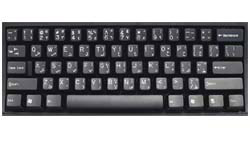
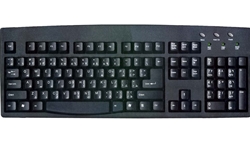

Arabic Opaque Keyboard Labels - White Letters on Black


Arabic Opaque Keyboard Labels - White Letters on Black

Previous  Up  Next" 
Arabic 101 Opaque Keyboard Labels

E-mail this product to a friend E-mail this product to a friend


Arabic keyboard labels are a high-quality, durable and inexpensive solution for converting your keyboard into an Arabic (101) keyboard layout. These labels are available in white letters on black, opaque labels.

In stock
Regular Price: $14.95
 On Sale For: $12.95 


Quantity:   
Specifications
Features
Setup
Use

Specifications

Arabic (101) - White letters on black, opaque labels.

The Arabic (101) labels support the Arabic keyboard layout in Bahrain, Egypt, Iraq, Jordan, Kuwait, Lebanon,Libya, Oman, Qatar, Saudi Arabia, Syria, U.A.E., and Yemen.The label set includes two sets of number labels so you can elect to use Latin style numbers or Arabic language style numbers. This language is supported in Windows XP, Windows Vista and Windows 7; older versions of Windows will require an Input Method Editor (IME)from Microsoft or third-party software.

We also have the Arabic (102)keyboard labels that support Arabic in Algeria, Morocco,and Tunisia.

The Arabic (101) labels are a very economical option for creating an Arabic keyboard. The language labels use an easy peel-and-stick method to install. They will not damage the original keyboard key. The letters are printed on the underside of the labels so that the lettering will not wear off. This affords you with many years of durable use. 

Installing DataCal Keyboard Labels

The DataCal Arabic label set includes both Arabic style and Latin style number labels. You can choose which style you wish to use. If you choose the Arabic style numbers, you must configure your software to print the correct style.

Because Arabic text entry is right-to-left, certain characters, such as the parentheses, brackets, braces,etc. are on different keys in different software applications. For example, in Microsoft Word, the left parentheses is on the "9" key. In MicrosoftWord Pad, the left parentheses is on the "0" key. The DataCal Arabic keyboard label set includes labels for both configurations. You should check your software that you use the most and install the correct labels required byyour software.

DataCal language labels are designed to fit desktop and laptop computer keyboards.

Labelsize: 7/16" w X 9/16" H (11mm W X 14mm H)

Features

  • Durable labels. Labels are manufactured of durable Lexan®. They won't tear, crack, discolor, or slip off even after years of use.

  • Quality Printing. The printing is on the underside of the label so the INK NEVER WEARS OFF OR SCRATCHES OFF.

  • Easy to Apply. The labels are EASY TO APPLY. The labels are printed in the same sequence that they appear on the keyboard regardless of the keyboard's original language. If necessary, labels can be cut with scissors for special installations.

  • Quality Adhesive. The Label adhesive firmly attaches the label in place without damaging the keyboard key or the original key legend.

  • Removable. If desired, Labels may be removed without causing damage to the original key or the legend on the key.

  • Accurate Die-Cutting. Labels are printed with rounded corners so they cover the keytop and will not pop off in use.

  • Complete Alphanumeric Set. The label sets include labels to cover all of the alphanumeric keys on the keyboard. The sets do not include the function keys, the control keys, or the numeric keypad.

  • Durable and Flexible. Labels are flexible enough to allow you to feel the touch-typing bumps on the F and J keys.

How to setup Windows for Arabic

Setup instructions for Arabic 101 in Windows Vista and Windows 7 

Setup instructions for Arabic 101 in Windows XP

Earlier versions of Windows do not support the Arabic 101 keyboard. You will have to secure fonts and a keyboard layout from another vendor to be able to type in Arabic.

Instructions for Typing in Arabic inWindows

Numbers in Arabic Labels

The DataCal label sets for Arabic (101) and Arabic (but not Arabic 102) include both Latin style numbers and Arabic style numbers. Microsoft Word allows the user to select either number set. Other Windows applications, such as Microsoft Excel, WordPad, etc., do not allow the user to select; only the Latin style characters are available in these other applications.

If you would like to configure Word 2000 (orlater) to use Arabic style numbers, follow these steps:

1.    Click on Tools > Optionsin the Word menu bar.

2.    Click on the Right-to-Left tab (or the Complex Script tab) in the Options dialog box.

3.    In the Numeral section,click on the arrow to the right of the scroll box and select: Context (notArabic).

4.    Click on OK to complete the selection.

When you select the Arabic language in Word and type numbers, you will see Arabic language style numbers instead of the Latin style numbers.

Arabic Parentheses

The DataCal Arabic 101 and Arabic label sets feature the parentheses ( ), brackets [ ], and braces { } reversed from the English placement (see picture below).

This character placement is correct for Windows applications including Microsoft Excel, WordPad, etc. It is not correct for Microsoft Word. When you type these characters in Microsoft Word, they will type in the exact opposite of the placement of the labels. This is due to an inconsistency in how Microsoft Word handles these specific characters in Arabic. If you wish to type Arabic almost exclusively in Microsoft Word, you may wish to reverse the location of these characters. To do this, you will need to cut the label into a top half and a bottom half and place them on the correct keys. If you choose to cut the labels apart, you can cut them with scissors before you remove them from the label backing. If you remove them from the adhesive backing and then cut them, you may damage the label adhesive.